

.eco-post{max-width:820px;margin:0 auto;line-height:1.7}
.eco-post .lede{font-size:1.18rem;color:#0b1d3a;font-weight:500;margin:0 0 1.4rem}
.eco-post h2{color:#0b1d3a;margin:2rem 0 .7rem;font-size:1.5rem}
.eco-post h3{color:#3B6FA5;margin:1.4rem 0 .5rem;font-size:1.18rem}
.eco-post table{width:100%;border-collapse:collapse;margin:1.1rem 0}
.eco-post th,.eco-post td{border:1px solid #e2e8f0;padding:.6rem .7rem;text-align:left;font-size:.97rem}
.eco-post th{background:#eef4fb;color:#0b1d3a}
.eco-post .callout{background:#eef4fb;border-left:4px solid #3B6FA5;padding:.9rem 1.1rem;border-radius:6px;margin:1.2rem 0}
.eco-post .cta{background:#0b1d3a;color:#fff;border-radius:12px;padding:1.4rem 1.6rem;margin:2rem 0}
.eco-post .cta a{color:#a9c4e5;font-weight:600}
.eco-post .faq h3{font-size:1.05rem;color:#0b1d3a;margin-top:1.1rem}
Bad breath is one of those problems almost nobody brings up at the front desk — patients mention it quietly, halfway through the cleaning, usually after a pause. If that’s you, here’s the honest version: chronic bad breath is rarely about skipping a mint. About nine times out of ten it starts in the mouth, and that means it’s fixable. At our office on Ocean Avenue in Brooklyn, halitosis is one of the most common things we quietly solve, and we’d rather you ask.
First, the difference between “morning breath” and a real problem
Everybody wakes up with some odor. Saliva slows down overnight, bacteria multiply, and you get that familiar morning taste. A swish of water, breakfast, and brushing clear it within minutes. That’s normal.
What we treat is the kind that doesn’t go away — breath that’s back an hour after you brush, a metallic or sour taste that lingers, or a partner who has started turning their head. That persistence is the signal. It usually means bacteria have a place to live that your toothbrush isn’t reaching.
Where the smell actually comes from
The odor itself is sulfur. Specific bacteria living in low-oxygen pockets break down food debris and dead cells and release volatile sulfur compounds — the same family of molecules behind the smell of rotten eggs. The question is always where those bacteria are hiding. In our experience, it’s one of these:
| Source | How common | Tell-tale sign |
|---|---|---|
| Back of the tongue | Very common | White or yellow coating; smell returns fast after brushing |
| Gum disease (gingivitis / periodontitis) | Common | Bleeding when you floss, gums pulling back |
| A cavity or failing filling | Common | Food traps in one spot; bad taste localized to one tooth |
| Dry mouth | Common, often missed | Worse on medications, after sleep, or for mouth-breathers |
| Tonsil stones, sinus drainage | Occasional | Smell with no obvious dental cause; post-nasal drip |
The gum-disease connection people underestimate
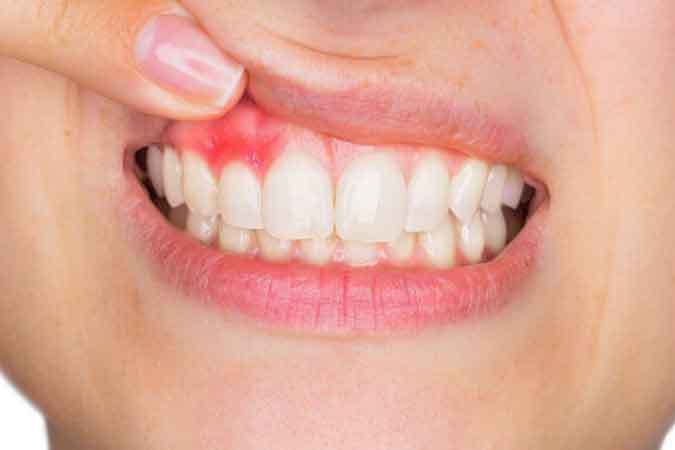
If your breath is persistent and your gums bleed when you floss, those two facts are almost certainly related. Gum disease creates little pockets between tooth and gum where oxygen can’t reach — a perfect home for the bacteria that produce sulfur gases. You can scrub all day and never reach inside that pocket. This is exactly why mouthwash alone disappoints people: it rinses the surface and leaves the source untouched.
The fix here isn’t a stronger rinse, it’s a deep cleaning that clears the pockets, plus treating the gum disease itself. If you’ve noticed your gums looking different lately, our guide on receding gums and what causes them is worth a read alongside this one.
Dry mouth: the cause nobody suspects
Saliva is your mouth’s rinse cycle. It washes away food, neutralizes acid, and keeps bacteria in check. When it drops, odor climbs. We see dry-mouth-driven bad breath constantly in patients who:
- take blood-pressure, allergy, or antidepressant medications (very common culprits)
- breathe through their mouth, especially at night
- don’t drink much water through a long work day
- are going through menopause or other hormonal shifts
If this sounds like you, the answer often has nothing to do with more brushing — it’s hydration, a humidifier at night, sugar-free xylitol gum to trigger saliva, and a conversation about timing your medications. Simple, but it works.
What you can fix at home this week
Before you spend money on every product at the pharmacy, try the basics done correctly for two weeks:
1. Clean your tongue, properly
Use a tongue scraper (a few dollars at any drugstore) or the back of your toothbrush. Reach as far back as you comfortably can and pull forward, rinsing between passes. Do it twice a day. This is the single highest-impact change for most people.
2. Floss like you mean it
The smell trapped between teeth is the smell on your breath. If your floss comes out with an odor from one specific gap, that gap is talking to you.
3. Hydrate and skip the alcohol rinse
Drink water through the day. Avoid mouthwashes with high alcohol content — they feel sharp and clean for ten minutes, then dry your mouth out and make the problem worse by evening. An alcohol-free antibacterial rinse is fine.
4. Notice your triggers
Coffee, garlic, onions, and very low-carb “keto” diets (which produce their own distinctive breath) all play a role. You don’t have to quit anything — just know what’s yours.
What we do when you come in
An appointment for bad breath in our Brooklyn office is mostly detective work, and it’s not uncomfortable. We look for the obvious mechanical sources first — a cracked tooth holding food, a cavity, a leaking filling, an ill-fitting crown. We check your gums for pockets and bleeding. We talk about your medications and your water habits. If everything in the mouth is genuinely healthy and the odor persists, that’s when we’ll point you toward your physician or an ENT, because sinuses, tonsils, reflux, and a few medical conditions can be the real driver.
Most of the time, though, it’s dental, and the relief of finally naming the cause is something patients tell us about for months. A professional cleaning, fixing one problem tooth, and a tongue routine you’ll actually keep up — that’s the usual recipe. If a failing filling or a cracked tooth turns out to be the source, treating it (sometimes with a crown or a fresh filling) solves the smell and the structural problem at once.
Frequently asked questions
Can I tell if my own breath smells bad?
Usually no — you’re desensitized to your own odor. Licking the back of your wrist, letting it dry, and smelling it is a rough home test. The most reliable check is simply asking someone you trust, or asking us during a visit.
Why does mouthwash only work for a little while?
Most rinses mask odor and kill surface bacteria for an hour or two but never reach the real sources — gum pockets, the back of the tongue, the inside of a cavity. Once the alcohol-based ones wear off, they can leave your mouth dry and the smell stronger.
Is bad breath always a dental problem?
Around 85–90% of chronic cases start in the mouth. The rest trace to sinuses, tonsil stones, acid reflux, uncontrolled diabetes, or certain medications. We rule out the dental causes first because they’re the most common and the easiest to fix.
Will a deep cleaning get rid of it?
If gum disease is the cause — and it often is — then yes, clearing the pockets makes a dramatic difference. We’ll know within one exam whether that’s your situation.
How soon can I be seen in Brooklyn?
We keep room for prompt appointments and we’re open Monday through Friday. Bad breath isn’t an emergency, but you don’t have to live with it for weeks either — call us and we’ll get you in.
Tired of guessing? Let’s find the actual source.
Dr. Natalia Blazhkevich, DDS — Eco Dental NY, 2384 Ocean Avenue, Brooklyn, NY 11229. Call (718) 368-3368 or book online. We speak English, Russian, Polish, Ukrainian, and Uzbek.
{“@context”:”https://schema.org”,”@type”:”FAQPage”,”mainEntity”:[
{“@type”:”Question”,”name”:”Can I tell if my own breath smells bad?”,”acceptedAnswer”:{“@type”:”Answer”,”text”:”Usually no, because you are desensitized to your own odor. Licking the back of your wrist, letting it dry, and smelling it is a rough home test. The most reliable check is asking someone you trust or asking your dentist during a visit.”}},
{“@type”:”Question”,”name”:”Why does mouthwash only work for a little while?”,”acceptedAnswer”:{“@type”:”Answer”,”text”:”Most rinses mask odor and kill surface bacteria for an hour or two but never reach the real sources such as gum pockets, the back of the tongue, and the inside of a cavity. Alcohol-based rinses can also dry the mouth and make breath worse once they wear off.”}},
{“@type”:”Question”,”name”:”Is bad breath always a dental problem?”,”acceptedAnswer”:{“@type”:”Answer”,”text”:”Around 85 to 90 percent of chronic bad breath starts in the mouth. The rest traces to sinuses, tonsil stones, acid reflux, uncontrolled diabetes, or certain medications. Dentists rule out dental causes first because they are the most common and easiest to fix.”}},
{“@type”:”Question”,”name”:”Will a deep cleaning get rid of bad breath?”,”acceptedAnswer”:{“@type”:”Answer”,”text”:”If gum disease is the cause, which is common, then clearing the gum pockets with a deep cleaning makes a dramatic difference. A single exam can determine whether gum disease is responsible.”}},
{“@type”:”Question”,”name”:”How soon can I be seen for bad breath in Brooklyn?”,”acceptedAnswer”:{“@type”:”Answer”,”text”:”Eco Dental NY keeps room for prompt appointments and is open Monday through Friday. Patients can call (718) 368-3368 to schedule a visit at the Ocean Avenue office in Brooklyn 11229.”}}
]}